Poème Symphonique Numérique: Recreating Ligeti's 100 metronomes in software
05 Apr 2024
•
audio
•
art
•
software
•
machine-learning
...
Sometime in the fall of 2022, I was talking to my colleague Dr.Peter Edwards about modernist composer György Ligeti's upcoming 100-year birthday. We soon discovered that we had a mutual fascination for Poème Symphonique, his piece for 100 mechanical metronomes, and began discussing the prospect of performing it live. However, after discovering how expensive it is to buy 100 mechanical metronomes, we started questioning whether it would be possible to model the synchronization behavior that happens between the metronomes in software.
I was facinated by this topic and spent a great deal of time after my conversation with Peter researching algorithms and models for synchronizing oscillators in the digital audio realm. Eventually, my curiosity led me to create an audio software version of Poème Symphonique that uses the Kuramoto model and a realtime ML-based sound engine. This post shares how I made the software and provides some relevant backstory on Poème Symphonique and the Kuramoto model in music research.
To watch a full demo of my piece, visit the link at the bottom of the post. Also, find the full source code for my project on my GitHub page.
Poème Symphonique
Born in 1923 Hungary, György Ligeti is one of the great modernist European composers. Ligeti was especially renowned for his sound-texture explorations and works within the minimalism movement. In fact, if you've seen Stanley Kubrick's sci-fi epic, 2001: A Space Odyssey, then you have heard some of Ligeti's music before. In the film, the alien monoliths are sonically themed by one of Ligeti's great choir pieces, namely Lux Aeterna.
Poème Symphonique is an earlier piece by Ligeti, composed in 1962, for 100 mechanical metronomes. On stage, the metronomes are split into equally sized groups and placed on solid resonator surfaces, like tabletops. The metronomes are then wound to their maximum capabilities and given a tempo between 50 and 144 BPM. The piece is performed by starting the metronomes at arbitrary times and lasts until the metronomes have run out of mechanical energy.
The unique thing about Poème Symphonique is the synchronization phenomenon that happens (and between) within the metronome groups. Since they share a common resonator (the tabletop), the metronomes are coupled, meaning that their behavior is directly affected by the behavior of their coupled partners. The effect is that the interacting metronomes synchronize to different rhythmical patterns over time.
I think Poème Symphonique says something important about our perception of music. It's also an interesting reminder of the fascinating properties of oscillations and rhythm in the natural world.
Synchronization with the Kuramoto Model
Synchronization can be defined as an interaction between independent rhythmical processes. It's a natural process we can observe everywhere, from the light pulses of large groups of fireflies, to musical ensembles reaching a state of rhythmical unity. Technically speaking, the result of synchronization is a transition to phase equality (θ ≡ θ), for all oscillators in a system, at a rate described by how much they are interacting/coupled.
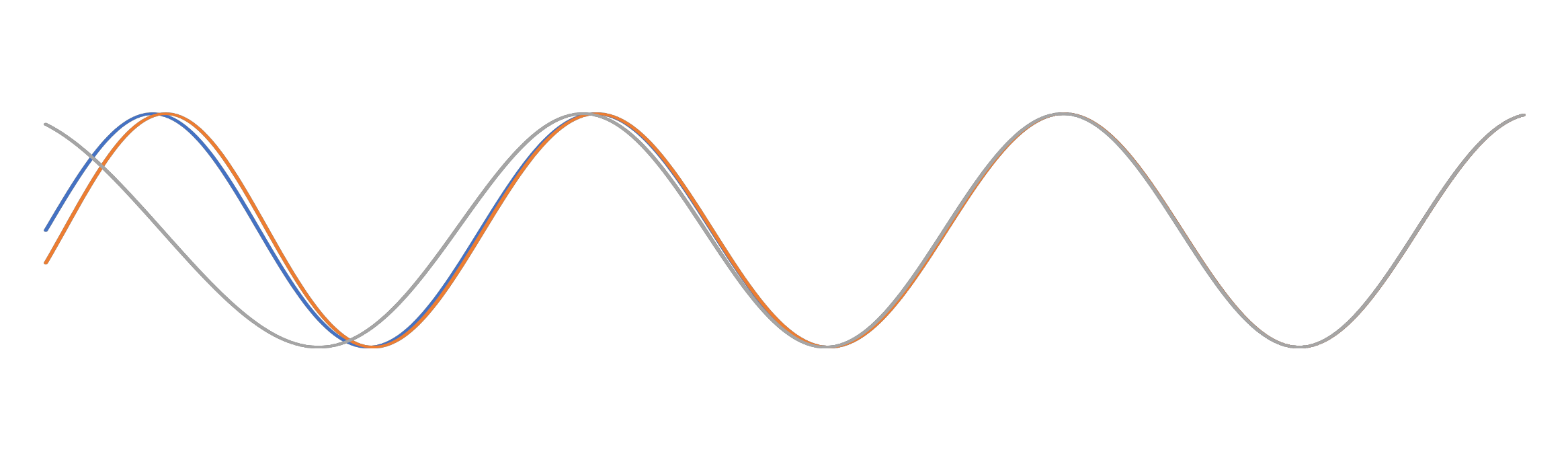
The Kuramoto model is a simple and well-known mathematical framework for understanding synchronization in globally coupled non-linear oscillators, developed by Yoshiki Kuramoto in the 1970s. In simple terms, this algorithm describes really well how groups of interacting oscillators synchronize, like what we experience with Ligeti's metronomes or the fireflies. I was first introduced to the Kuramoto equation through a great video by Matt Parker on Syncronizing Metronomes in a Spreadsheet.
In the governing Kuramoto equation, seen below, the phase (θ) of an oscillator is extracted by calculating the sine of difference between all oscillators (N) in the system. The strength of the interaction between the oscillators is determined by the coupling constant (K), a parameter that also controls the rate of synchronization. Also, the fundamental frequencies (ω) of the oscillators must be added.

Kuramoto-like models have had an impact on a variety of scientific fields, including music. A big part of music research with the Kuramoto model has revolved around new complex forms of synthesis, studying how we can derive complex behavior from simple oscillator systems, experimenting with generative synthesis, sonification applications, and even waveshaping. Rythmn studies is another research area where these models have been put to use (of course, you might think). Some of these studies have experimented with self-organizing rhythmical systems and intelligent systems that can enable better musicking between humans and machines/robots.
Bringing the Kuramoto Model to Max
Why did I choose the Max language/software? Well, for starters, I know Max, and its cousin Pure Data, really well. I've built tons of software with both environments and am therefore quite familiar with the boundaries and possibilities of both. Max is also awesome when working with audio, specifically when you're prototyping something complicated that you need to work in a real-world musical setting, quickly. Finally, since Max also features so many good UI elements, it’s also easy to quickly design good-looking software. It’s an all-in-one package, really.
I started my metronome-coupling project as any sane person would do: I searched online for other audio versions of the Kuramoto Model done in Max by other people, hoping I could use one of them as my point of departure. During this process, I actually came across several usable candidates. Most notable was the Kuroscillator objects developed by Nolan Lem in Faust for Max. But although Nolan's implementation is elegant and supportive of both synthesis and rhythm synchronization, it wasn't designed in the way that suited my project. It was also difficult to understand the underlying mechanics, as I am not familiar with the Faust language. Faust is also a third-party dependency that I didn't want my Max code to be dependent upon in the future, for maintenance reasons. Finally, and more importantly, Nolan's objects wouldn't scale well to 100 individual virtual metronomes. This is because the Kuroscillators were made in the regular MSP audio domain in Max (as of 2025). No, to scale well for a 100+ number of metronomes, I had to make use of the relatively new and revolutionary multi-channel audio domain in Max, the MC environment.
These reasons were enough to make me excited about designing my own MC Kuramoto model object in Max. However, before I could start, I had to formulate a set of requirements to help guide my development process and make explicit what I needed:
-
The object should support an arbitrary number of oscillators in the MC environment in Max. In other words, it should be equally simple to use with 2 oscillators as with 200 oscillators.
-
The user should be able to toggle oscillators on/off at arbitrary times, mimicking how you start and stop a mechanical metronome.
-
The user should also be able to change the oscillator frequencies and adjust the coupling constant (K-value) at arbitrary times.
-
One shared K-value should apply for all oscillators in the system. Also, setting a K-value equal to 0 should bypass the Kuramoto effect and return the oscillator phases to their original state.
-
For maintainability, the implementation should be 100% coded in Max, meaning no third-party dependencies.
The result was alx.ksync, a simple Max abstraction where users can toggle sine waves and decide when they should start to synchronize with each other. With alx.ksync, the user decides how many oscillators they want to be part of the system by specifying it as a number in the creation argument of the object. For example, in the image below, notice that the object is set to 16 channels. I've currently tested my object with 500 oscillators, and although my CPU was not happy, it worked fine (I take zero responsibility for what you do on your laptop).
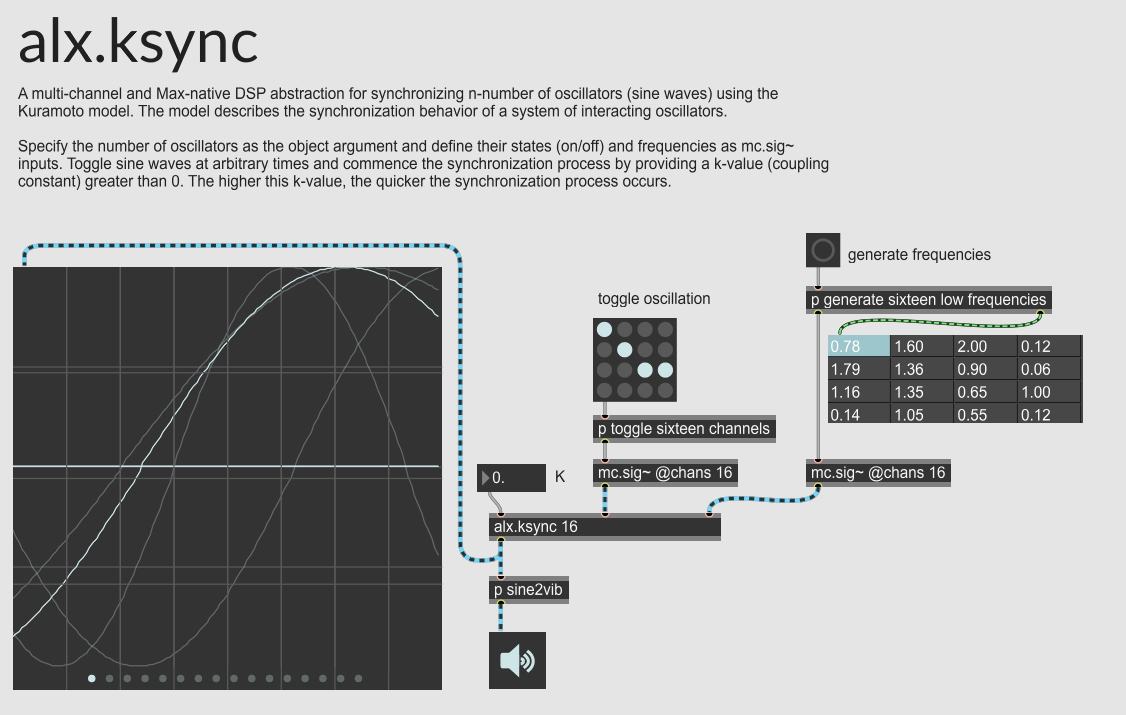
As you can see in the image above, the ksync object has three inlets. The first is for the coupling constant (K-value) which decides how coupled the oscillators are and thus how fast they synchronize. The second inlet is for oscillator states. This is where you can turn individual oscillators on/off at will. The last inlet is for individual oscillator frequencies. Yes, you can specify different frequencies for each oscillator. Having some deviation here helps to model how metronomes work in real life more accurately. Once you toggle the oscillators, the object outputs sinewaves that will synchronize over time.
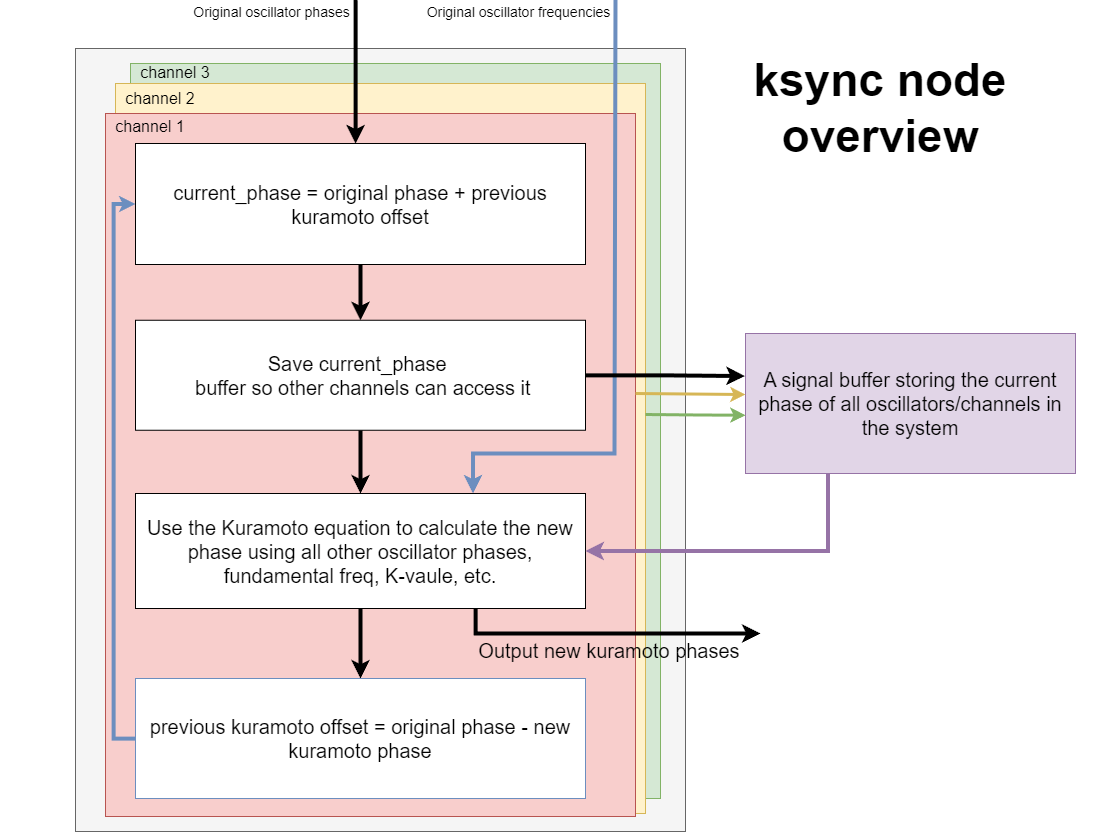
We can take a closer look inside the [alx.ksync] object in the slideshow below. Inside, there is a ksync node (or nodes, really) together with some governing logic and basic math. The ksync node is the heart of the software. It's an object itself, written in the Max-native gen~ language, and its job is to offset the phases of the oscillators continuously, goverened by the Kuramoto equation. In other words, this is where the Kuramoto model is actually in effect. The addition logic and math are there just to turn the input parameters into nice sinusoidal outputs, seamlessly.
I had the most trouble with finding an elegant solution to requirements 1 and 2: making the ksync node support an arbitrary number of audio channels (decided by the user) and giving users the ability to turn on/off oscillators at any given time. The main issue culminated in finding a dynamic way for each channel to have access to the current phase of every other channel in the system, an important component of the Kuramoto equation. In the end, I sought guidance from my brilliant coder friend, Balint Lazcko, who proposed a solution using an external buffer to hold the current oscillator phases. This was exactly the solution I was looking for.
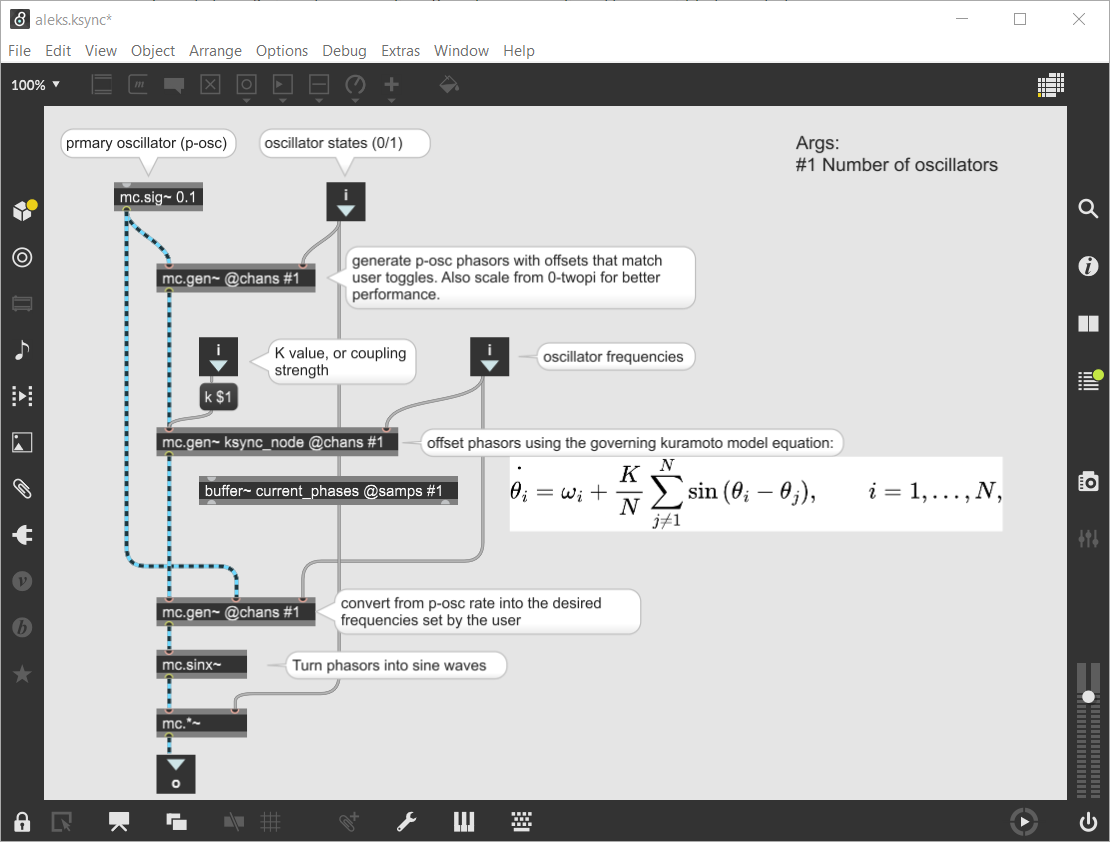
Finally, since my code was designed to run at audio-rate in real-time, I had to make some minor adjustments to the Kuramoto algorithm to support DSP in Max. The implementation also required some extra scaling and fine-tuning. For example, I had to scale the coupling constant (k-value) and natural frequencies to the system sampling rate to get usable performance. Fortunately, you can access all kinds of system variables globally in the Max multi-channel gen~ environment, like the channel count, channel, and sampling rate. This is super handy! Thank you Cyclin' 74.
Clustering together a sound engine
Since the output of alx.max are simple sinewaves, I had to design a sound engine that was able to convert the sines into audible metronomes. The first iteration of alx.ksync came with a simple playback system that triggered audio samples at every zero-crossing, imitating the "tick"-characteristics of a metronome well. All I needed for my project was a clever way to decide what sound was played on what channel.
Similar to my Kuramoto model, I first established a few requirements for my sound engine:
- Every oscillator/metronome should have a unique sound.
- All sounds should be "of the same class". For instance, only clap sounds.
- It should be possible to toggle (on/off) the metronomes from a 2D matrix-like interface.
- The position of the metronomes on the 2D interface should be related to their sound characteristics (timbre).
For some time, I have been interested in machine-learning libraries for Max designed for realtime audio. In particular, I've wanted to explore libraries like SP-tools that give users the ability to build corpora of sounds and process them in realtime. I decided to use SP-tools for my project to design an interesting sound engine that used clustering techniques on drum machine audio corpora. I started by hunting likable sounds, collecting two 100-sample datasets of clap and clave sounds from my large bank of drum machine sounds. Then, I used my datasets to create audio corpora based on MFCC audio frames and filters for onset, RMS, and similar descriptor types.
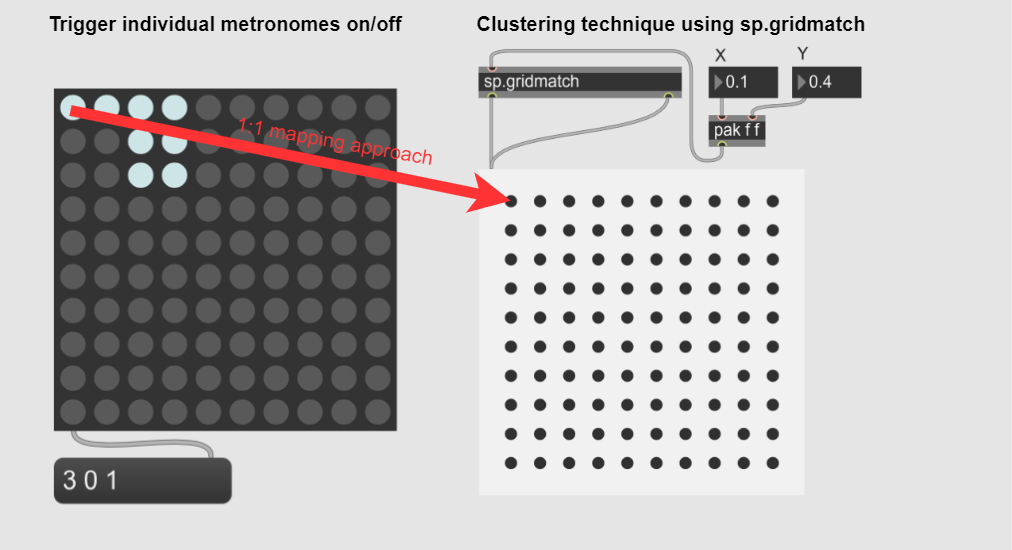
It was important for me to create a link between the visual location and audible timbre of the metronomes. For this, I needed a good audio clustering algorith. I decided to use sp.gridmatch, an object that finds the nearest match in a corpus based on a grid-ified XY space, using some nearest neighbor-like algorithm. With gridmatch, you can arrange clusters to fit a 2D surface specifically and use simple XY coordinates to control the audio playback. Perfect.
Below is an audio example of clusters produced by gridmatch on my clave dataset. Notice the difference in sound texture between the clusters, even though every sound is a drum machine clave:
Loading audio...
When I was happy with my sound space, I created a 1:1 mapping scheme between the gridmatch clusters and a group of four matrixctl objects. The matrixctl objects functioned well as metronome triggers and by chaining together multiple of these objects I could create one interface that would satisfy the metronome division score requirements.
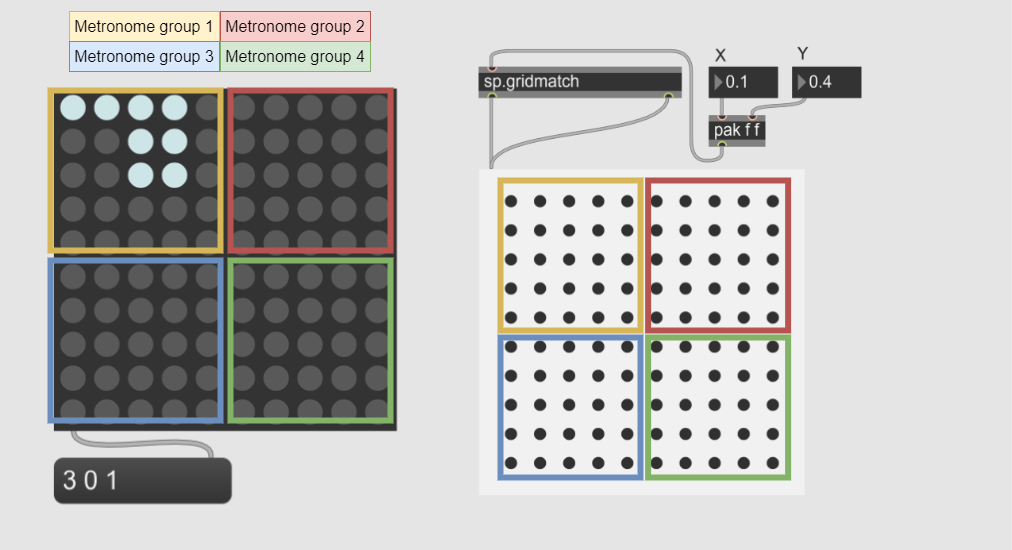
Finally, I connected each matrixctl group to its own instance of aleks.ksync to create a system where only metronome groups were coupled together.
See a demo
So there you have it, my software rendition of Ligeti's Poème Symphonique for 100 metronomes, my Poème Symphonique Numérique. In my video demo, I tried to follow the score as much as possible but also practiced some artistic freedom by gradually starting the metronomes one by one, manually turning them off again at the end instead of waiting for them to wind down by themselves, and giving each metronome group a slightly different coupling strength for the Kuramoto model.
I hope you've found this interesting. You can find the full source code for my project of my GitHub profile.
Sources and further reading
Chakraborty, S., Dutta, S. & Timoney, J. 2021. The Cyborg Philharmonic: Synchronizing interactive musical performances between humans and machines.
Dörfler, F., & Bullo, F. 2014. Synchronization in complex networks of phase oscillators: A survey. Automatica, 50(6), 1539–1564. https://doi.org/10.1016/j.automatica.2014.04.012
Daniels, B. 2005. Synchronization of Globally Coupled Nonlinear Oscillators: The Rich Behavior of the Kuramoto Model. ResearchGate. https://www.researchgate.net/publication/251888882_Synchronization_of_Globally_Coupled_Nonlinear_Oscillators_the_Rich_Behavior_of_the_Kuramoto_Model
Essl, Georg. 2019. "Iterative phase functions on the circle and their projections: Connecting circle maps, waveshaping, and phase modulation." 14th International Symposium, CMMR, France.
Nolan Lem. 2022. ‘Constructive Accumulation: A Look at Self-Organizing Strategies for Aggregating Temporal Events along the Rhythm Timbre Continuum’. Sound and Music Computing Conference. France.
Lem, N. 2019. Sound in Multiples: Synchrony and Interaction Design using Coupled-Oscillator Networks. Sound and Music Computing Conference. Spain
Lem, N. 2023. The `Collective Rhythms Toolbox": An audio-visual interface for coupled-oscillator rhythmic generation. Sound and Music Computing Conference. Sweden.
Lem, N., & Orlarey, Y. 2019. Kuroscillator: A Max-MSP Object for Sound Synthesis using Coupled-Oscillator Networks. CCRMA, Stanford University.
Lem, N., & Fujioka, T. 2023. Individual differences of limitation to extract beat from Kuramoto coupled oscillators: Transition from beat-based tapping to frequent tapping with weaker coupling. PLOS ONE, 18(10), e0292059. https://doi.org/10.1371/journal.pone.0292059
Maes, P.-J., Lorenzoni, V., & Six, J. 2019. The SoundBike: Musical sonification strategies to enhance cyclists’ spontaneous synchronization to external music. Journal on Multimodal User Interfaces, 13(3), 155–166. https://doi.org/10.1007/s12193-018-0279-x