The Standstill Station - How still can we be?
19 Feb 2026
•
art
•
installation
•
motion
•
rhythm-and-time
...
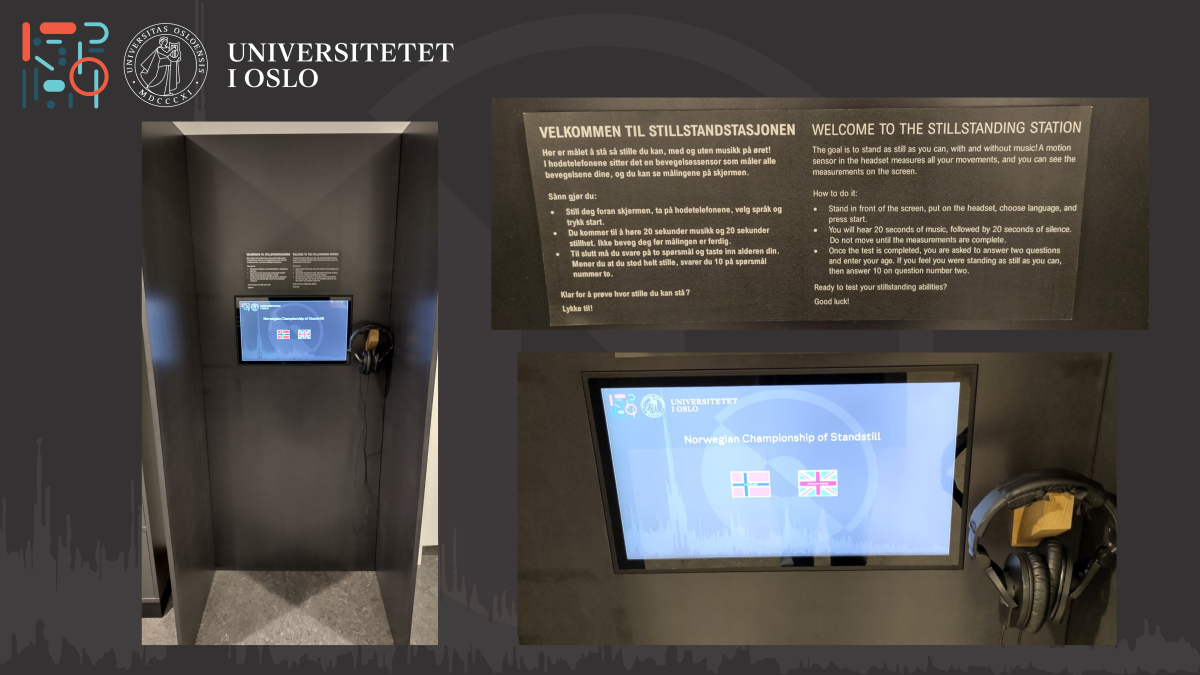
The Standstill station is an art-science installation that hosts the Norwegian championship of Standstill, a challenge to see who can move the least. Users put on a pair of headphones and are asked to stand still for 40 seconds while listening to music and silence. The movements are tracked by a small gyro placed inside the headphones, and the movement data is displayed to the user on screen in real-time. After each trial, users can see how well they perform compared to all previous participants.
The exhibit was originally developed by Joachim Poutaraud, Julius Jacoby-Pflug, and Alexander Jensenius in 2023, as part of a collaboration between RITMO Centre of Excellence at the University of Oslo and the Popsenteret museum in downtown Oslo. In 2026, after Popsenteret closed, the installation was updated and revitalized at the Department of Musicology, at the University of Oslo, by Aleksander Tidemann.
This post just a quick overview of how the installtion is made and how it can be used.
How it's made
The system consists of a large physical structure, a touchscreen computer, and a pair of headphones with a gyroscope inside. The wooden structure is custom-made and places the user inside a half-box, creating an immersive space that allows for focused attention. All electronics are fastened to the back of the structure. Only the headphones, touchscreen, and documentation plaque are visible.
The headphones-gyro hybrid is also a custom-made device where a small gyro is hidden inside the headband of a pair of headphones. Their cables are also intertwined and run through an encompassing cable, so all you see is a clean pair of headphones with an unusual Ethernet connector at the end. The Ethernet port adapter effectively separates the gyro and audio signals, again, so they can be connected to the computer via USB-A and mini-jack (3.5mm).
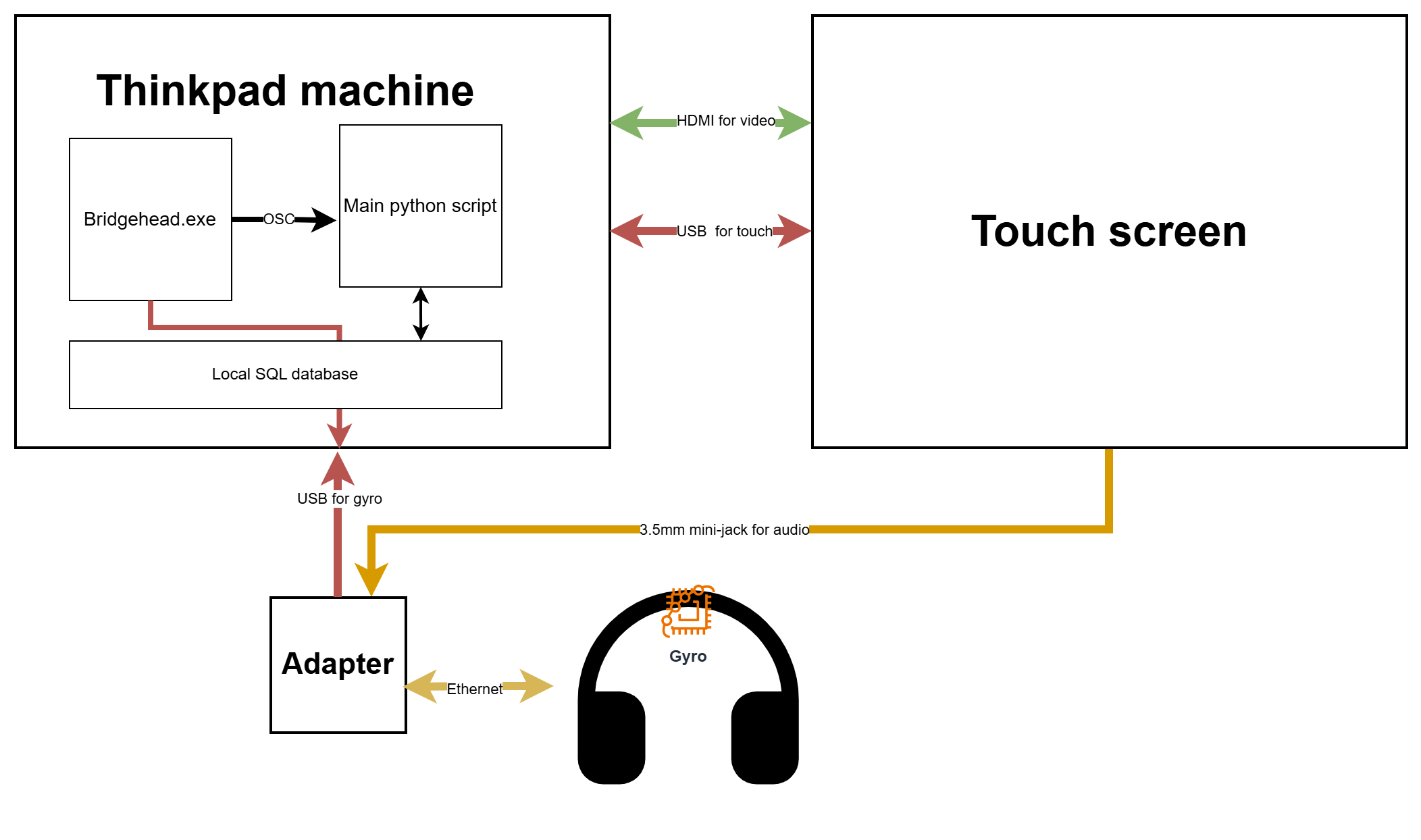
All the system software runs inside a small ThinkPad M70q Windows 10 desktop machine mounted on the back of the structure. Software-wise, the standstill station requires three programs:
- A main Python script that handles the UI, data, calculations, and database storage, etc.
- A bridge software that converts and sends the 3D head-tracking data (XYZ) from the gyro to the main Python script via OSC. If you want to do development on the Standstill station, this OSC stream can easily be spoofed by setting up a local OSC stream. Just use the correct network info and schema.
- A local SQL database for storing and retrieving data. It's important that this server is configured to run in the background of the machine from boot. I just use SQL Workbench to set everything up. I also put a number of pings in the code to awaken the server if the installation has been running for a while.
Yes, the standstill station records and retrieves data from all its users and displays this data in real-time. The user can therefore see how well they performed against all other participants. This is quite fun to watch and gamifies the whole experience.
Main takeaways and roadmap ahead
The main challenge of getting the Standstill station up and running was ensuring reliable runtime in a restricted university environment. I had to ensure that it could run for weeks and months on end, without failing, even if no one used it, standing alone in the halls of my department. Previously, at Popsenteret, the installation ran on a small ThinkPad M70q desktop machine, with Windows 10, connected to a remote SQL server over the network. When revisiting the piece, I used the same machine but made a local database, keeping the SQL infrastructure but avoiding the heavily restricted network here at my university. As for usability, the Windows ThinkPad works great. It's easy to navigate and doesn't require a lot of know-how to configure. Good for development and easy prototyping. However, Windows will always be unreliable in the long run. A Linux solution on a Raspberry Pi or desktop machine would probably be best if the project ever gets revisited, yet again.
To make a Windows machine function as an installation machine, some system configuration is absolutely necessary. First, always ensure that the machine reboots at least once a day, preferably at night when nobody uses it. The reboot sequence is necessary to clear memory and mitigate potential freezes that will occur at some point. There are many ways to schedule recurrent tasks in Windows, but I thought it best to do this through Windows' native Task Scheduler. To locate this software, right-click on the Windows icon and launch the Computer Management app. For the reboot sequence to work, you must also create a Task that starts the main Python script and the bridge application (between the gyro-headphone hybrid and the Python script) when the machine restarts. Luckily, this can also be done with the Task Scheduler. Finally, for the software-starting sequence to work, you have to ensure that there's no Windows user login required when the machine starts, and that the Windows sleep/power settings are turned off so the machine never goes to sleep.
The SQL database solution also functioned pretty well, but over time I noticed timeout issues when the software was left unattended for longer periods. Here, I added some code to ensure that the database regularly was pinged and woken up every time some activity was detected. For now, this seems to work fine, but I might have to install more safety features along the way. Local databases are easier to configure and have fewer points of error, but they're also a lot riskier. If the machine fails now, all data can be lost. So, in the future, if the local database solution continues, I would opt to install a backup drive somewhere in the chain as a safety measure.
Another big challenge I encountered was with how users interacted with the UI. They kept messing up the software and finding new ways to break it. This is actually an unfair criticism as most UI concerns reflect directly back on the developer. We always underestimate the many ways in which things can break. Or, said in another way, there is only one way for something to work and an infinite number of ways for it not to work. However, the UI bugs on the Standstill station were pretty obvious. For example, I noticed that users could easily avoid certain steps in the procedure (like not fill in their age or how they enjoyed the music etc.,) and just hit continue all the way. Stuff like this. So, to mitigate, I added more safety code to ensure that sessions could not be completed without all necessary info provided. But failures are bound to happen. As I said. So, it's wise to program with that in mind. For instance, make the data storing work even when the types sometimes are wrong.
Anyway, it seems that the theme here was striking a balance between usability (easy to use) and reliability (works forever). Trading off one to get the other, and vice versa.
Where can I see it today?
The Standstill station is currently located at the Department of Musciology at UiO, at this address. It's free and open to everybody so if you're in the area, please stick by and test it for yourself. It stands in the Epicentre, a break room/study facility in the middle of the building. First floor.
Source code and full documentation
You will find much more technical information about the Standstill station on it's dedicated GitHub reporsitory. In this codebase, there is detailed info on how to setup the SQL data handling, how to do development, and how to install and run the software.
If you want to build it yourself one day, feel free to get in touch with us about specifics.